(Contra)Bassoon of the Week: Heckel Contrabassoon
May 22nd, 2026
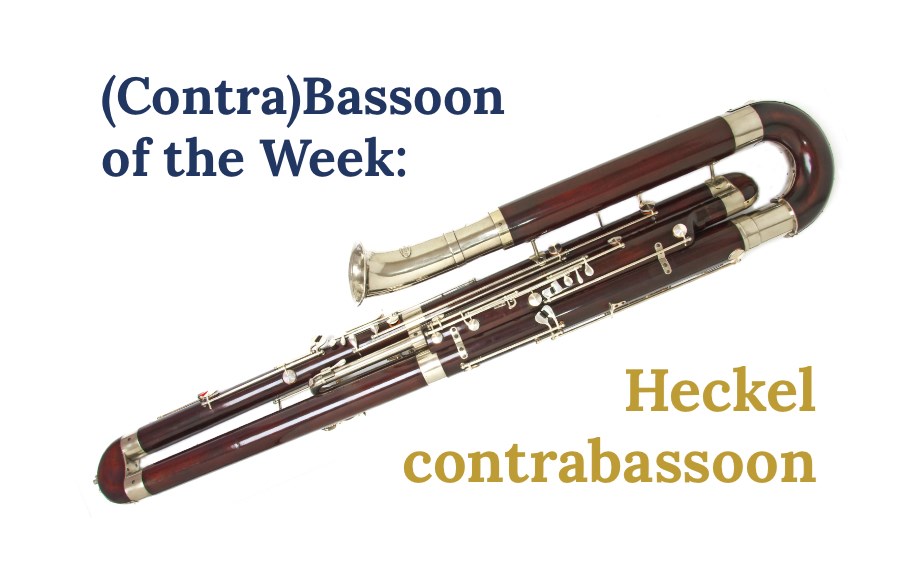
(Contra)Bassoon of the Week: Heckel Contrabassoon
Our Bassoon of the Week this week is not a bassoon; it is a contrabassoon.
In fact, a Heckel contrabassoon.
What is a contrabassoon?
For those unfamiliar with the contrabassoon, it is an adaptation of the standard bassoon with a longer bore. It plays an octave lower than a bassoon but uses very similar fingerings in the lower register (but sounding an octave lower), where it spends most of its time. This means that any bassoonist, with some practice, can pick up and play a contrabassoon – although to become expert, and particularly to play in the high register, is not so straightforward.
As the contrabassoon plays an octave lower than a bassoon the bore is roughly twice the length. To keep it a manageable size it has multiple 180 degree turns rather than just the one for a bassoon. An exception to this is the historical contrabassoon which had one turn like a bassoon, and therefore could approach three metres in length when assembled!
The contrabassoon is usually regarded as the lowest-playing instrument in the orchestra, and can play at or very close to the lowest note on a standard 88 key piano - A0 or Bb0.
What to look for in a contrabassoon
There are five things to look out for when considering investing in a contrabassoon.
1. Size. Contrabassoons rarely come apart so have to be transported as they are. The lowest-playing contrabassoons (down to A0; known as low A contras) are usually the longest.
Considerations are: whether it will fit in your car or can you manage it on public transport?
A gig bag with backstraps helps to keep it manageable; a traditional case can be unwieldy and heavy but gives more protection.
2. Intonation and tone quality. Contrabassoons are difficult to make with very good intonation, and this is where the main difference lies between less expensive and more expensive instruments. Tone quality is also a factor, and more refined instruments have broader, warmer sounds.
3. Projection. There can be quite large differences between how well contrabassoons project, from very quiet, muffled tones, particularly at the lower end of the range, to clear, loud and projecting tones. Again, the more expensive the contrabassoon the better the projection will tend to be.
4. Keywork. While mattering less than on a bassoon, keywork does vary quite a lot between contrabassoons. Lots of rollers and trill keys are rare but can be a bonus, particularly for professional players.
5. Condition. Contrabassoons are rarely overhauled, and many provide service for decades with little or no attention; albeit declining slowly in intonation, projection and ease of playing. As a contrabassoon becomes more and more leaky over time, it has to be blown harder to get it to sound, until it becomes quite a strain to play. It is amazing how many people get used to playing like that though!
If you have to blow very hard to get your low notes to sound, or they stutter, then the instrument does need a service to improve the seal.
They are expensive to overhaul, however - explaining why they rarely are overhauled. If the seals between the joints are leaking, necessitating complete disassembly, then costs can mount, so it is best to buy one which has already had all the work done to a high standard.
Perhaps surprisingly, what matters little is age: contrabassoons have not changed much acoustically since about 1900. We have had many contrabassoons in over the years from new to 100+ years old, and some of the best sounding are the older ones. Condition and who made the contrabassoon are much more important.
The Heckel contrabassoon we have for sale
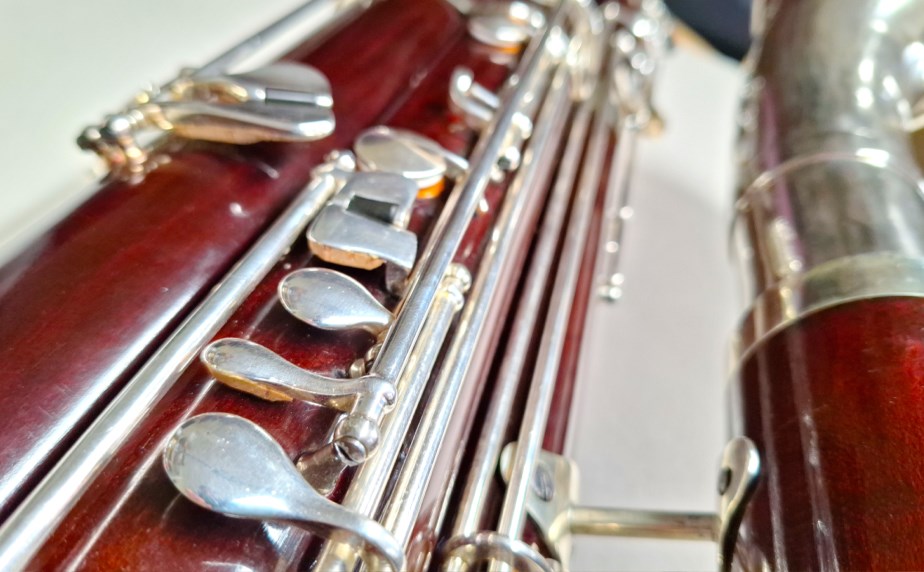
View it here: Heckel Contrabassoon
Although Heckel didn’t invent the contrabassoon, they had a lot to do with the development of the modern contrabassoon we all know today. Theirs are regarded as some of the finest contrabassoons money can buy. Very few Heckel contrabassoons come up for sale anywhere in the world in a single year and we are fortunate to have this one. It has the following attributes.
- Descends to low Bb in a compact form, so is easily handleable, helped by its gig bag with back straps
- Has fantastic intonation, having been carefully tuned during its latest overhaul
- Projects really well
- Low notes may be played pianissimo with good clarity and resonance – a sign of an acoustically well-refined contrabassoon
- Simple fingerings work well in the higher register
- Has plenty of keywork including six rollers, a low E link to high notes vent for better tuning and tone quality (left thumb), unusual left hand 2nd finger E-F# trill key, and an automatic link between low F and low F#
- Is in outstanding condition having been very carefully overhauled by an expert bassoon/contrabassoon technician prior to our receiving it, including re-silvering all the keywork to a high standard
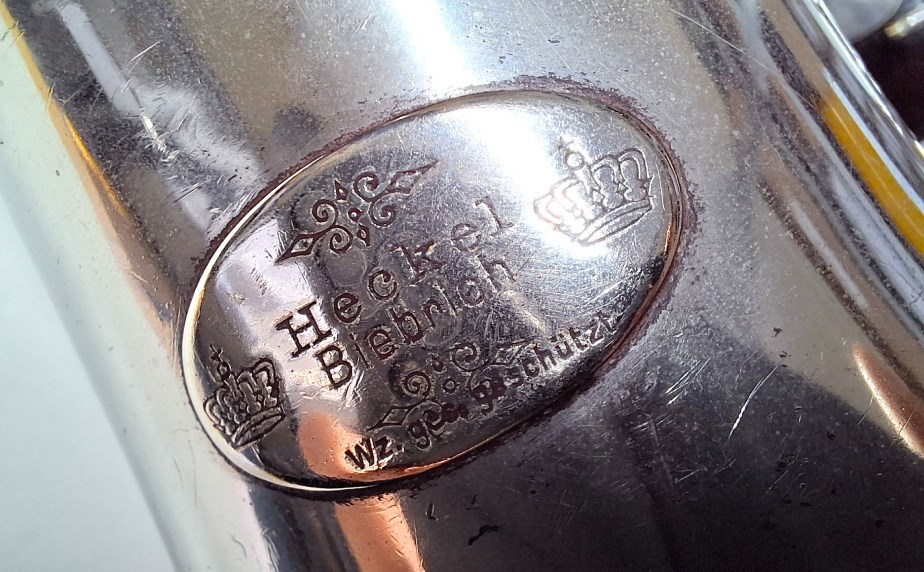
Oliver Ludlow comments:
“We have had many contrabassoons in over the years and I think this is one of the best we have had so far. It’s stunning to look at, in mint playing condition, projects exceptionally well, and has the elusive round, warm Heckel sound everyone loves.
“I particularly like how balanced the intonation is – simple fingerings for the highest notes work well, which is a sign of a top quality instrument.”
Try it for yourself
If you are interested in this Heckel contrabassoon please get in touch.
Owing to its size we are unable to send it for a trial under our Try Before You Buy scheme, but you are very welcome to visit us to try it and then take it away for a trial (UK only). We are confident you won’t be disappointed.