An Amazing Piece of Bassoon-Making History
January 16th, 2026

A Rescue Operation
In 1991, the Hüller bassoon factory in Schöneck, Saxony closed its doors for the last time. Word soon spread that its machinery, tooling, reamers, and even its stores of aged maple were about to be scrapped. Upon hearing the news, Maarten Vonk*, one of the world’s leading bassoon repair specialists, immediately drove to Schöneck in the hope of saving what he could.
He arrived just in time to rescue a small handful of items. When he returned the next day, however, everything else had already been scrapped and the factory cleared. For a craft that relies on highly specialised, irreplaceable tooling, the loss was immense.
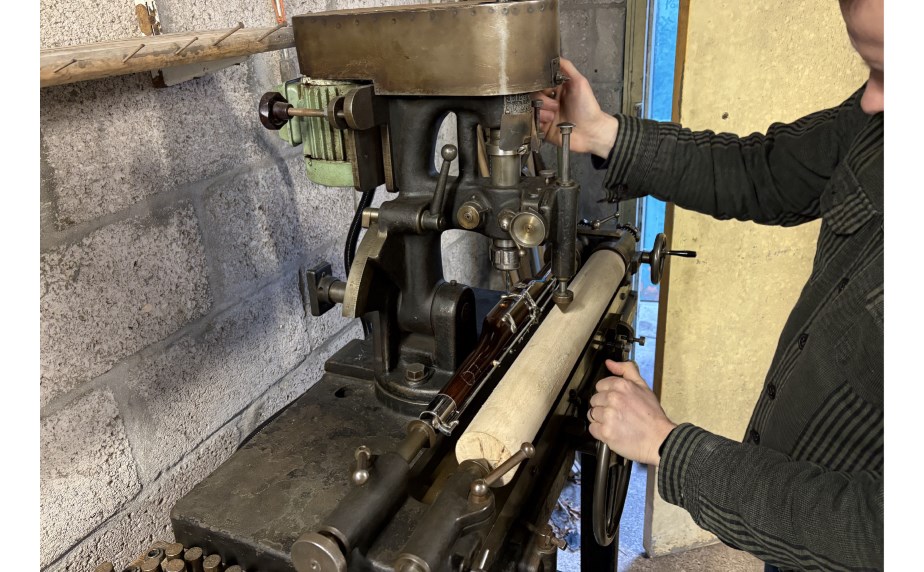
Among the few pieces he managed to save was the extraordinary Julius Berthold woodwind drill copy machine shown in our photos. Very few of these were ever made, and even fewer survive today.
A Machine Built for Bassoon Precision
This machine was purpose-designed for drilling tone holes and performing complex angled operations for bassoons and other woodwind instruments. Its accuracy is astonishing: it holds joints rigidly and places holes exactly where they must be acoustically, whether straight or angled. It is built across five axes, allowing precision drilling that would be very difficult and slow to achieve by hand or on a standard drill press.
For decades, Maarten used it for high D and E key installations and for other precision upgrades and repairs. Anything involving new holes—fitting posts, adding trill keys, enlarging or re-facing tone holes—can be carried out on this machine with remarkable control.
When he retired, he kept this machine aside. It was too rare, too historically important, and too potentially useful to let go. Earlier this year, he offered it to us.
The Journey to the UK
Maarten and Yasmin Sollie of Sollie Muziek, another bassoon specialist company in Holland, made the journey from the Netherlands to Newport, transporting the machine on a trailer. For us, the real gift was not only the machine itself but also the opportunity to spend time with Maarten—absorbing his experience, knowledge, and stories from decades of bassoon work—as well as discussing future collaborations with Yasmin.

We are now the proud owners of the original Hüller bassoon tone-hole drilling machine.
Why This Tool Matters
Tone-hole drilling is one of the most critical stages in building a bassoon. Unlike most woodwind instruments, many of the bassoon’s tone holes are angled, and these angles contribute significantly to its warm, woody, resonant character. Achieving those angles consistently demands equipment of exceptional precision.
This machine enabled Hüller to produce bassoons with reliable, repeatable accuracy. It is no exaggeration to say that thousands of bassoons were made on this very machine—almost certainly including most surviving Hüllers still being played today. To have it in our workshop, still fully functional, is to hold a tangible piece of 20th-century bassoon-making heritage.
A Once-Thriving Instrument Maker
Hüller was founded by Gottlob Hüller in 1878 after he trained at Heckel. By its 50th anniversary in 1928, the company was producing more than 11,500 instruments a year, including many bassoons. It also became one of the world’s largest saxophone makers.
After World War II, Schöneck fell within the Soviet-controlled part of Germany, and Hüller—like many makers in the region—was nationalised, merged, and starved of investment. Production of most instruments ceased in the late 1980s, and even bassoon making became unviable after reunification. In 1991, the factory closed permanently.
The drill copy machine was one of the key pieces of equipment behind Hüller’s bassoon production, especially for the notoriously difficult angled tone holes. It ensured accuracy, speed, and consistency—qualities that defined Hüller bassoons for generations.
Who Made This Specialist Machine?
The machine was built by Julius Berthold & Co. of Klingenthal, only a short distance from Schöneck. Berthold was a leader in precision woodwind-making machinery in the late 19th and early 20th centuries. They were best known for their reed-making machines for harmonicas but produced advanced equipment for a wide range of instruments.
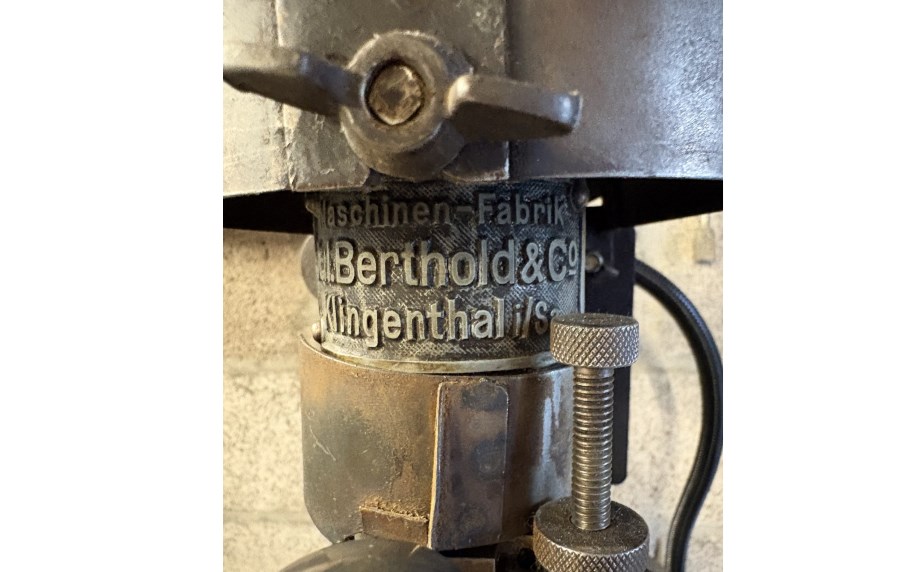
Their mechanical copy machines were predecessors to the CNC routers used by modern makers. Where CNC machines follow a digital model, these early devices followed a physical “master,” reproducing its details mechanically with remarkable fidelity.
A Mechanical Precursor to CNC
While copy lathes shaped the outside profile of an instrument, this drill copy machine replicated tone-hole positions and angles. It is beautifully built, engineered with the durability and precision typical of early 20th-century machinery.
If your bassoon was made before CNC machining became the norm—essentially anything made before the 2000s—there is a good chance that a machine like this played a role in its creation.
What Comes Next?
Like Maarten, we intend to use the machine for:
- high D and high E key installations
- drilling post holes
- enlarging or re-facing tone holes
- angled drilling during major overhauls
- tasks too intricate for hand work but not worth programming on a CNC machine
And who knows what else we may discover it can do. One day, it may even find its place in the Veriam Music Trust museum as an important piece of our craft’s heritage.
*Maarten Vonk, founder of FagotAtelier Maarten Vonk and author of A Bundle of Joy: A Practical Handbook for the Bassoon (2007). The story of rescuing this machine is also recounted on pp. 116–117 of his book.